
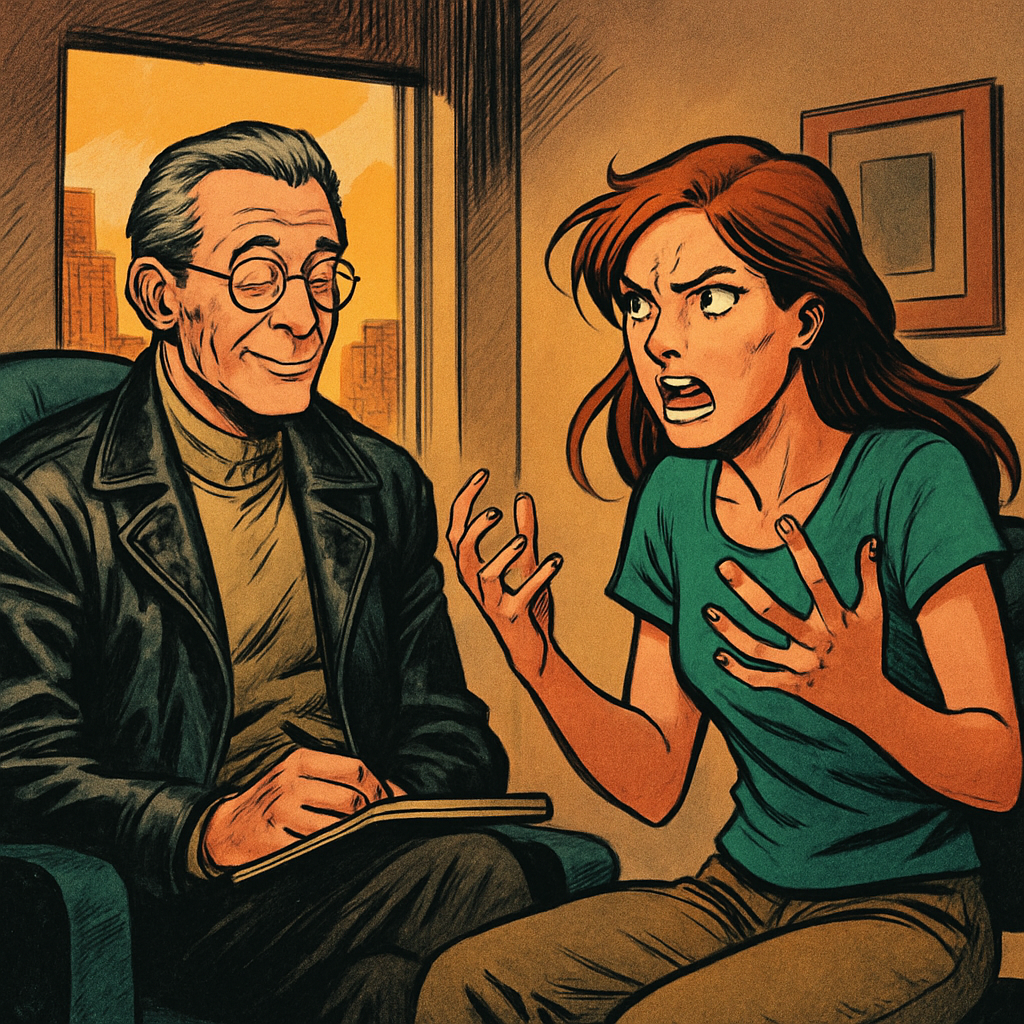
I remember Zephyrine K. because most clients come in looking for ways to fix their marriages, their careers, or themselves. Zephyrine wanted to understand why she couldn’t stop feeling guilty about not leaving a tip at Applebee’s. 😔
🎯 The Tipping Point
“I sat there for fifty-five minutes waiting for cold food,” she told me during our first session, voice tight with frustration. “And my parents agreed the service was terrible. So why do I feel like I’m the villain in this story?”
What struck me wasn’t the situation itself but how deeply it had lodged in her emotional landscape. This wasn’t just about fifteen percent on a check. This was about something far more fundamental: how we navigate the gap between what we expect from others and what we feel we owe them in return.
As we dug deeper, I learned something fascinating about Zephyrine – she’d spent three years as a server herself during college. “That’s the thing that’s killing me,” she confessed. “I know exactly how hard that job is, and I’ve always been the person who overtips because of it.”
📝 The Invisible Contract
Every social interaction comes with an unwritten contract. At restaurants, the deal seems simple: they provide service, you provide payment plus gratuity. But these contracts are loaded with emotional bytes – those packages of sensation, feeling, need, and meaning that guide our responses without our awareness. 🧠
For Zephyrine, her emotional bytes around tipping were dense with contradictory information. There was the physical discomfort of hunger during a fifty five minute wait, the unpleasant charge of frustration, the unmet need for attention, and the narrative that “good people always tip, no matter what.”
These competing bytes created what I call an “emotional frame collision” – when two deeply held interpretive lenses crash into each other.
“Part of me feels like I stood up for myself,” she said, “and part of me feels like I’m a terrible person who punished someone who was probably just having a rough day.”
I’ve seen this pattern thousands of times. Men struggle with it constantly, particularly around money and respect. We’re taught that withholding resources is a valid response to poor treatment, but also that real strength comes from generosity regardless of circumstance. It’s not weakness to feel this conflict – it’s evidence of a sophisticated moral system at work. 💪
🔍 Reading Between the Lines
Here’s what most experts won’t tell you about tipping situations: they’re rarely about the money. They’re about power and helplessness.
“I couldn’t control anything about that experience,” Zephyrine realized during our third session. “I couldn’t make the food come faster. I couldn’t make the server pay attention to us. The only thing I could control was the tip.”
This is what I call the “Last Stand Principle” – when people feel powerless throughout an interaction, they’ll exercise control wherever they still can, often in ways that don’t actually address the original problem.
The truth is, withholding a tip doesn’t fix bad service. It doesn’t even reliably communicate what went wrong. It just creates a momentary feeling of justice that quickly fades into uncertainty. ⚖️
⚖️ The Balance of Things
What surprised Zephyrine most was discovering that her parents’ influence ran deeper than she realized. “They’ve always been the ‘speak to the manager’ type,” she told me. “I’ve spent my whole adult life trying not to be like that.”
This revealed what I call an “inverse emotional script” – when we’re so focused on not repeating someone else’s pattern that we create a rigid opposing pattern. Neither position allows for the flexibility real situations demand.
Factory-spec facts: our reactions to service interactions often have nothing to do with the present situation and everything to do with childhood patterns around respect, authority, and being seen.
The invisible structure at play in restaurant interactions is the profound power imbalance that everyone pretends doesn’t exist. Servers depend on tips for livelihood while having minimal control over many factors affecting the dining experience. Customers technically have choice, but social pressure and cultural expectations create a coercive environment where “optional” gratuity doesn’t feel optional at all. 🎭
🛠️ Practical Solutions
By our fifth session, Zephyrine had developed “emotional granularity” – the ability to break down overwhelming emotional states into more specific, manageable elements. Instead of “I feel guilty,” she could identify “I feel conflicted about my values,” “I feel concern for the server’s wellbeing,” and “I feel frustrated about not handling the situation differently.”
This granularity allowed her to develop the “Fair Assessment Protocol” – a simple mental checklist to evaluate interactions:
- What factors were within this person’s control? 🎯
- Did I clearly communicate my needs? 🗣️
- What would fairness look like from both perspectives? ⚖️
“I realized I never actually told the server how long we’d been waiting,” Zephyrine admitted in our final session. “I just expected her to know and fix it.”
💡 Core Insight
Truth is: the most difficult person to be honest with in any service interaction is yourself. Are you responding to what’s happening now, or to every similar situation from your past? That’s the mission-critical information most people miss.
We’re not taught to examine our emotional frames – those invisible lenses that color every experience before we even have it. We just react, then justify, then wonder why we feel unsettled afterward.
Strength isn’t what you think it is. Real strength is having the capacity to see beyond your immediate reaction to the complex human reality underneath it – and still make a choice you can stand behind tomorrow. 🌅
—Jas Mendola, knowing that a man’s greatest strength isn’t his ability to stand firm, but his willingness to reassess the ground he’s standing on
Further Reading:
The Science of Tipping – Dartmouth Tuck School of Business
Tipping Research Study – West Texas A&M University
Consumer Tipping Behavior Analysis – South Dakota State University
Service Industry Tipping Culture – University of Louisville
Psychology of Tipping Behavior – National Center for Biotechnology Information
Tipping Culture in America – Pew Research Center
Restaurant Tipping Research – University of Nevada Las Vegas