
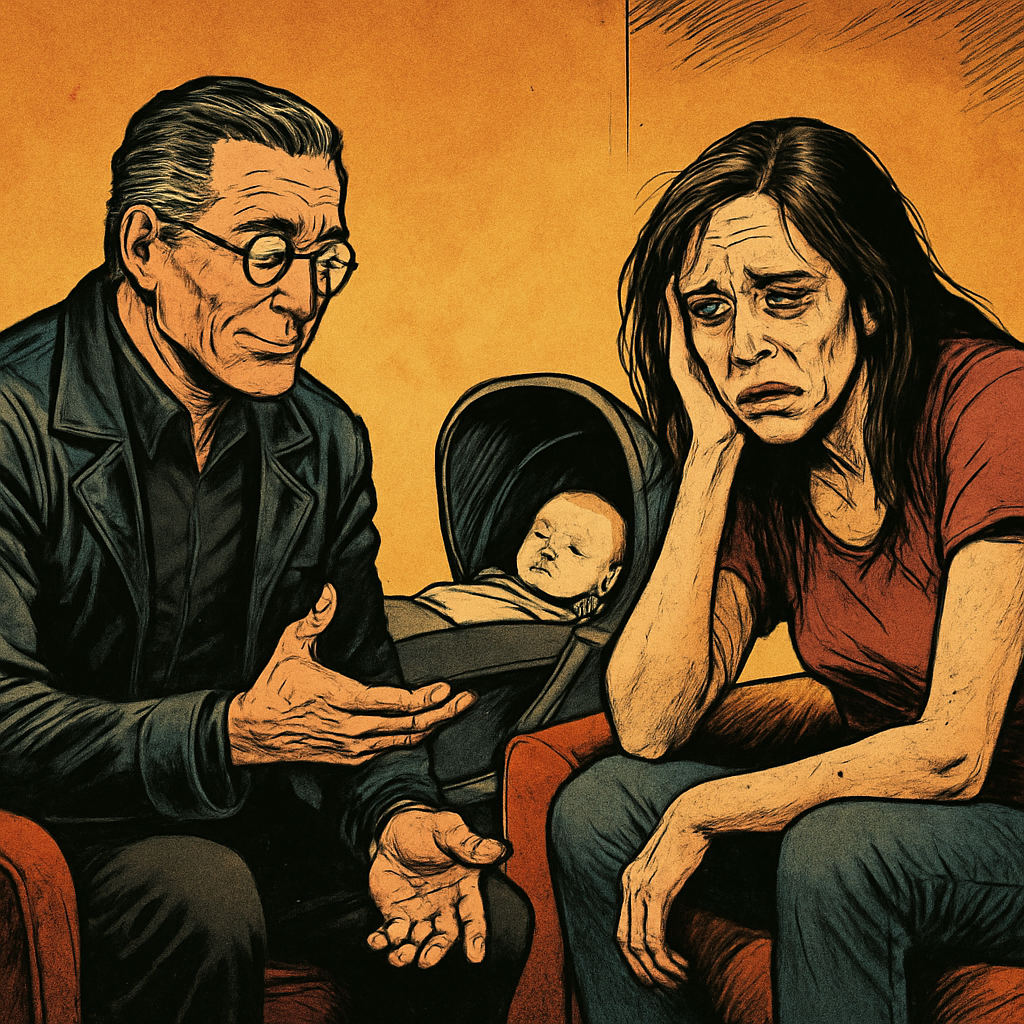
The night was quiet, but she was not. Her baby wailing, her partner seething, her body begging for sleep that never came. When she finally got it, it consumed her like a starving animal, and everything else – responsibility, relationship, even basic human connection – became secondary to the raw physical need of unconsciousness.
That’s how I remember Xanthea G.’s situation when she first came to my office – a new mother drowning in the undertow of sleep deprivation while everyone around her mistook her for someone lazily floating. 🌊
I remember Xanthea because she represented something I see constantly in my practice – the way we misinterpret each other’s behavior when we’re looking through entirely different emotional frames. Her partner saw a woman choosing to sleep rather than participate in their family. What I saw was a woman whose brain and body were in crisis, desperately trying to recover from a fundamental biological deficit that was rewiring her entire system.
When Sleep Becomes Survival, Not Laziness 😴
The human brain on chronic sleep deprivation is not the same brain. It’s not making excuses – it’s literally functioning differently. Xanthea’s case was classic: her 3-month-old’s sleep patterns had created a perfect storm of disruption that triggered a cascade of physical exhaustion, primal fear, and overwhelming inadequacy.
“Everyone thinks I’m just being lazy,” she told me during our second session, fighting back tears. “But it’s like my body isn’t mine anymore. When I finally get a chance to sleep, it’s like I’m possessed. I can’t fight it. Then I wake up and hate myself for missing everything.” 💔
What fascinated me was how her partner interpreted her excessive sleeping as a choice rather than a symptom. This is what I call a “frame collision” – two people experiencing the same reality through completely different emotional lenses. Her partner’s frame contained narratives about responsibility and fairness, while Xanthea’s frame was dominated by survival and recovery.
The secret most people don’t understand about new mothers like Xanthea: their brains are physically changing. Xanthea confided that she sometimes couldn’t remember her own phone number – something that terrified her but she was too ashamed to admit to anyone. This wasn’t laziness. This was her neural pathways being literally rewired by the combined forces of hormonal tsunami and severe sleep fragmentation.
What Her Partner Couldn’t See 👁️
Most men miss something fundamental about the postpartum experience: it’s not just about being tired. It’s about your brain chemistry being completely altered. Xanthea’s irritability, excessive sleeping, and seeming lack of motivation weren’t character flaws – they were her nervous system sending emergency signals.
“I feel like I’m going crazy,” she admitted during one particularly raw session. “Sometimes when the baby cries, I feel rage. Actual rage. Then crushing guilt. Then I just want to disappear into sleep where I don’t have to feel any of it.”
Each time her baby cried, her amygdala activated a threat response, but without adequate sleep, her prefrontal cortex couldn’t properly regulate that response. It wasn’t poor mothering – it was neurochemistry. ⚗️
Truth is, we’ve created a culture where new mothers are expected to perform motherhood perfectly while their bodies are in a state comparable to ongoing physical trauma. We wouldn’t expect someone with a broken leg to run a marathon, but we expect sleep-deprived new mothers to function as if their brains aren’t fundamentally altered.
The Real Crisis: Misunderstanding the System 🚨
Here’s the uncomfortable truth most men need to hear: your partner’s postpartum struggles aren’t a reflection on you, and they’re not something you can fix with logic or criticism. When I finally got Xanthea’s partner in for a session, he was fixated on what he saw as her “choices.”
“I understand being tired,” he said, “but she chooses to sleep through important appointments. She chooses to sleep instead of making dinner. I’m tired too, but I still function.”
This is where most men get it wrong. We’re conditioned to see everything through the lens of willpower and choice. But Xanthea wasn’t making choices in any meaningful sense. Her brain was in crisis mode, making emergency allocations of severely limited resources.
🎯 Core Insight: Men consistently overestimate how much of human behavior is choice-based rather than system-based. We like to think we’re captains of our own ships when often we’re just passengers on biochemical rollercoasters pretending to steer.
The Sleep Deficit Principle 💤
What I call “The Sleep Deficit Principle” is something every new parent needs to understand: Sleep isn’t a luxury your body can negotiate away – it’s as essential as oxygen. When deprived, your body will take it by any means necessary.
Xanthea’s seemingly “selfish” behavior was actually her system’s desperate attempt at self-preservation. Her brain was prioritizing recovery over everything – including relationships, responsibilities, and social expectations. The irritability, the “laziness,” the seeming indifference – these weren’t personality changes but symptoms of a system in crisis.
When I explained this to her partner, something shifted. “So you’re saying she’s not choosing this?” he asked.
“About as much as someone with pneumonia chooses to cough,” I replied.
What Actually Helped 🛠️
What ultimately helped Xanthea wasn’t conventional wisdom about “sleep when the baby sleeps” or “asking for help.” It was recognizing that her brain had been fundamentally altered by sleep deprivation and treating that as the primary problem to solve – not her seeming lack of motivation or irritability.
The Mission-Critical Information most men miss: When your partner becomes a mother, she’s not just adding a role – her entire neurochemical system is being reconfigured. The woman you knew before hasn’t become lazy or changed personalities – she’s operating with different hardware now. 🧠
Remember: a man’s greatest strength isn’t pushing through, but recognizing when the battle requires a completely different approach than the one that’s always worked before.
—Jas Mendola
—
https://www.omegapediatrics.com/sleep-deprivation-newmoms-copingstrategies/
https://pmc.ncbi.nlm.nih.gov/articles/PMC10092894/
https://www.mysweetsleeper.com/parentingblog/thescaryimpactofsleepdeprivationonmothers
https://scholar.dominican.edu/cgi/viewcontent.cgi?article=1205&context=nursing-senior-theses
https://boldhealthinc.com/the-impact-of-sleep-deprivation-on-postpartum-depression/