
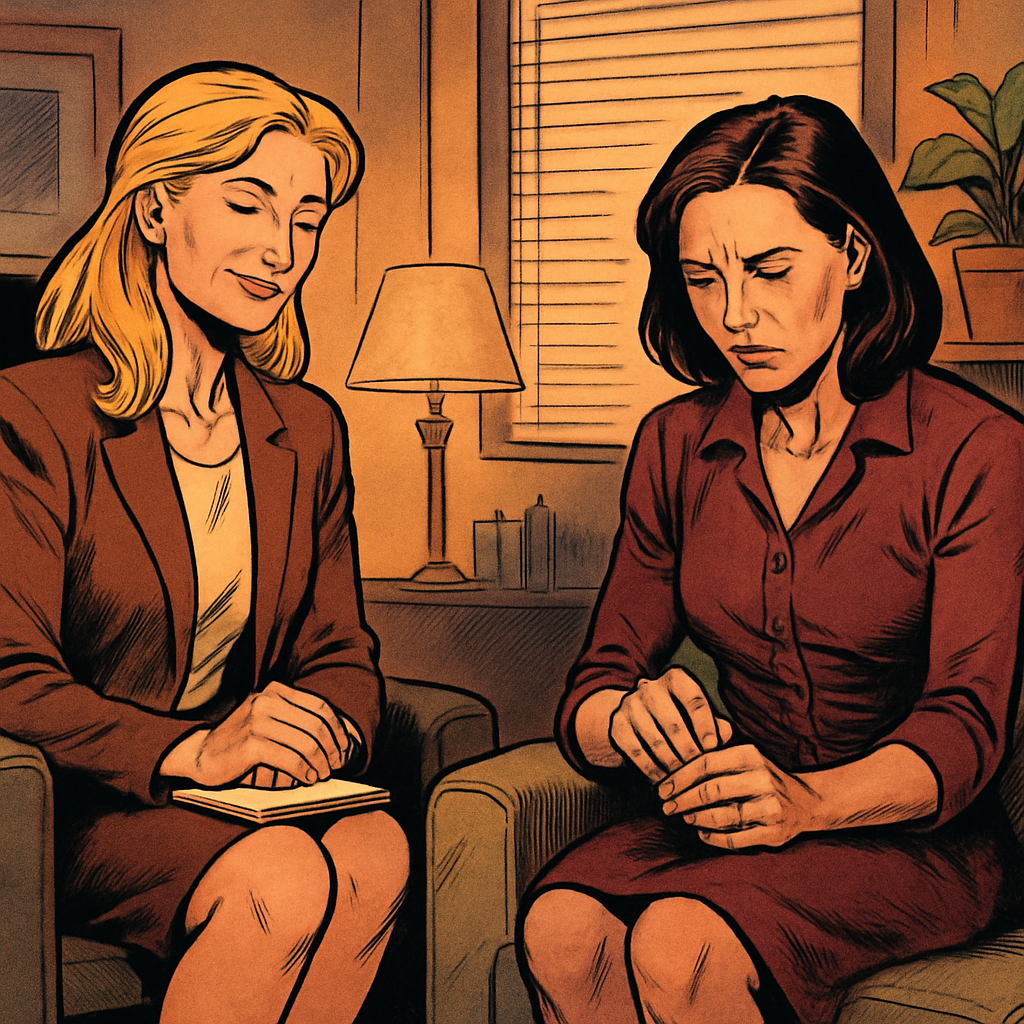
I still remember the day Michelle walked into my office, dressed impeccably in that power suit that screamed “I negotiate million-dollar deals before breakfast,” yet somehow radiating the unmistakable energy of someone who hadn’t slept properly in weeks. 💼
She sat down, crossed her legs, and delivered what I’ve come to recognize as the Manhattan Relationship Preamble: “Everything in my life is perfect except my marriage.” Perfect except for the one thing that matters most. I’ve heard this opening line so many times I should have it cross-stitched onto a pillow.
The Long-Distance Hangover 📱
Michelle and her husband had done the long-distance thing for years before finally settling down together. “He was so attentive then,” she told me, eyes glistening. “He’d send me these long, thoughtful texts. We’d have three-hour phone calls about everything and nothing. When we finally saw each other, it was like… magic.” ✨
Here’s what nobody tells you about long-distance relationships: they’re basically emotional highlight reels. You get all the deep conversation, all the anticipation, all the concentrated intimacy—without the mundane reality of whose turn it is to empty the dishwasher or pick up the screaming toddler at 3 AM.
When distance forces you to schedule communication, you inadvertently create sacred space for connection. Remove the distance, add a mortgage and a child, and suddenly those conversations happen… never.
“It’s like he spent years wooing me, and the minute I moved here, he considered the job done,” Michelle said, twisting her wedding ring. “Mission accomplished. Human acquired.”
The Invisible Second Shift 🧠
What struck me about Michelle wasn’t just her complaints—it was the emotional frames shaping how she interpreted every interaction. Each time her husband walked past a pile of laundry without noticing it, she wasn’t just annoyed about the laundry. She was receiving an emotional message loaded with meaning: I don’t matter enough for him to care about my experience.
“I’m drowning in invisible work,” she told me during our third session. “Not just the physical tasks—it’s the emotional management of our entire household. I track birthdays, notice when we’re low on toilet paper, remember which foods our daughter refuses to eat this week. He says ‘just ask for help’ like I should have to request basic partnership.” 🎯
The mental load isn’t just about tasks. It’s about carrying the responsibility for noticing what needs to be done. Each unnoticed need creates a tiny papercut of resentment. One is nothing. A thousand? That’s why Michelle flinched when her husband touched her.
The Prophecy of Resentment 💔
I’ve seen this pattern so many times, I can practically map its progression:
- You notice a need and address it
- Your partner doesn’t notice or address it
- You point it out (nicely at first)
- They respond temporarily
- The pattern repeats
- You stop asking directly and expect them to “just know”
- You begin collecting evidence of their failures
- Every interaction gets filtered through the frame of “they don’t care enough”
- Contempt enters, desire exits
- You become flatmates running a childcare facility together
Michelle had reached stage nine. “Sometimes I look at him and just feel… nothing. Or worse than nothing—irritation. He’ll reach for me and I have to stop myself from physically recoiling.”
When emotional wounds become suffused with resentment, they don’t just disappear with a date night and flowers.
Breaking the Script 🌟
What makes Michelle’s story stay with me isn’t the problem—it’s what happened next. Unlike many couples who come to me when the emotional concrete has already set, Michelle’s husband shocked me by showing up to our fourth session with a notebook.
“I don’t want to be the guy she’s describing,” he said quietly. “I just… I don’t see what she sees. But I want to.” 📝
It wasn’t an overnight transformation. They had to dismantle entrenched patterns—his avoidance of difficult conversations, her tendency to mother rather than partner, their shared script where she pursues and he retreats.
But they created something remarkable: a relationship that worked in proximity, not just across distance. The real work wasn’t learning to communicate—it was learning to truly see each other again, beyond the roles they’d fallen into. It was reconnecting with the people who once spent hours on the phone, fascinated by each other’s thoughts.
Michelle texted me a few month’s later: “We went to the park today. His idea, not mine. I felt that thing I haven’t felt in years—you know, that flutter when you look at someone and think, ‘oh, there you are.'” 💕
Core Insight 🎯
The greatest magic trick in relationships isn’t making problems disappear—it’s seeing the person you love clearly even when they’re driving you absolutely insane.
— Lola Adams, noticing that we’re all experts at assembling evidence that confirms our worst suspicions while dismissing the data that might heal us
https://purls.library.ucf.edu/go/DP0023472
https://pmc.ncbi.nlm.nih.gov/articles/PMC5635840/
https://www.uwlax.edu/globalassets/offices-services/urc/jur-online/pdf/2020/kuske.morgan.cst2020.pdf
https://vtechworks.lib.vt.edu/items/7648963f-e75f-4f6c-bbd1-37c0399f3678
https://business.cornell.edu/hub/2018/10/17/park-perspectives-long-distance-relationship/