
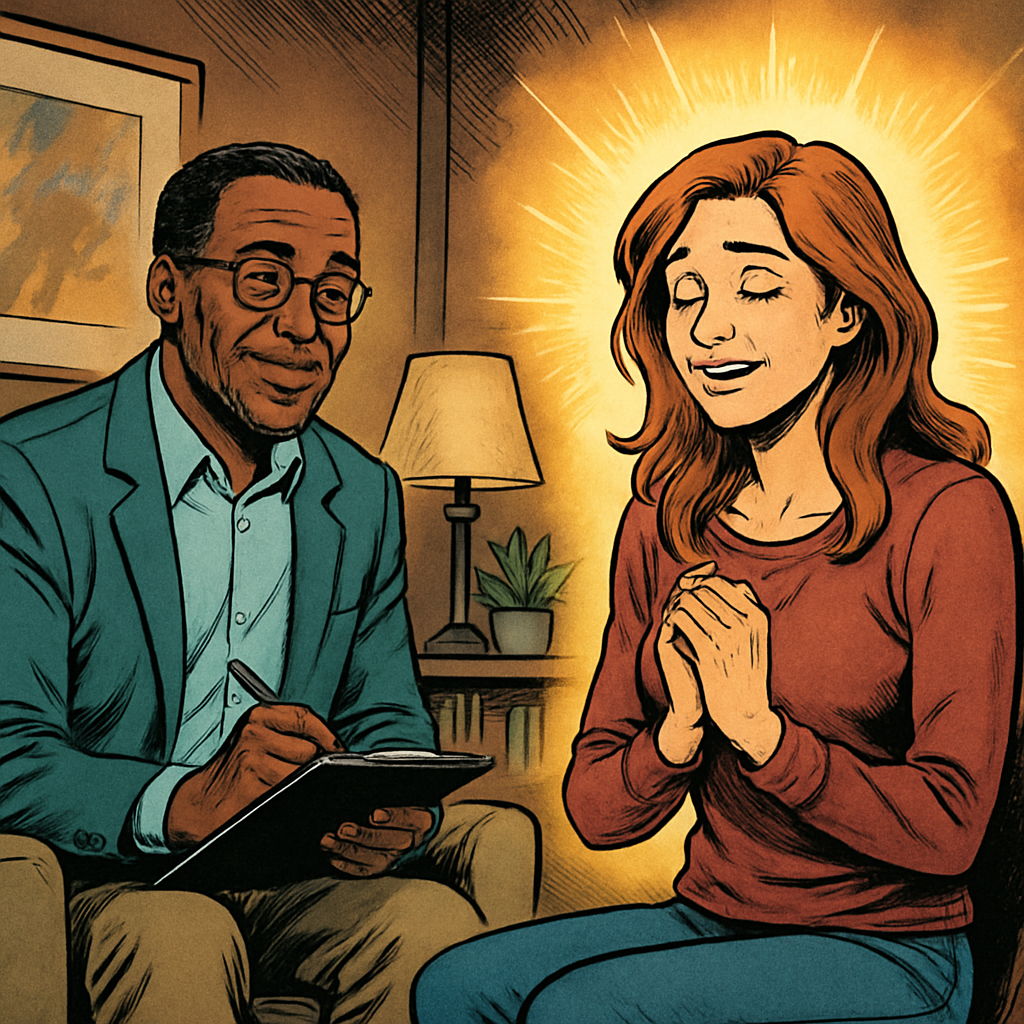
💔 When Needing Love Feels Like a Crime
Last week I watched a woman nearly burst into tears while admitting she enjoyed spending time with her friends. Not because the friendship was toxic, but because she felt guilty for wanting connection at all. As if the human need for love was some kind of character flaw she should have outgrown by now.
I wanted to laugh, until I realized how many of us walk around with this exact same broken operating system installed—where basic human needs feel like shameful weaknesses. Where did we collectively download this ridiculous software update? 🤔
🎭 Emily K: The Woman Who Apologized for Having Feelings
Emily K first came to my office three years ago, clutching her purse like it might shield her from judgment. “I’m not sure why I’m here,” she said, though we both knew that was a lie. Within twenty minutes, she’d revealed a childhood where emotions were treated as disorders, where her mother’s love was a reward for good behavior rather than a given, and where needing anyone for anything was considered pathological weakness.
“I just keep overextending myself in relationships,” she told me, “and then I feel resentful, but also guilty for feeling resentful, and then ashamed for feeling guilty… I sound crazy, don’t I?”
💸 The Hidden Tax on Human Connection
What Emily couldn’t see was how she’d internalized a narrative that human connection comes with a hidden tax—that needing others marks you as deficient. When she felt love toward her friends, that emotional experience carried not just the warm sensation of connection but also a sharp jolt of shame.
Research consistently shows this pattern doesn’t develop randomly. It’s precisely engineered by environments where emotional expression is met with pathologizing language or rejection. Where “you’re too sensitive” becomes the standard response to legitimate feelings.
What Emily was experiencing wasn’t some personal failure of independence. It was her emotional frames—those invisible interpretive lenses—telling her that vulnerability equals weakness.
🏆 The Independence Trap
Our culture fetishizes self-sufficiency. We’ve created a bizarre hierarchy where needing absolutely no one sits at the pinnacle of emotional health—which is exactly backward. The evidence actually suggests that healthy adults have both strong autonomy AND strong connection needs. They’re not opposites; they’re complementary systems. ⚖️
Emily’s fear wasn’t really about being “needy.” It was about being human in a world that had convinced her that humanity itself was the problem.
“What if,” I suggested during one breakthrough session, “you’re not actually ‘too emotional’ but instead struggling with completely normal emotional needs in a context that doesn’t acknowledge them?”
She looked stunned. “But everyone tells me I need to be more independent.”
“Independence isn’t the absence of need,” I explained. “It’s having the security to express needs without fear of abandonment.”
🌱 The Transformation
Over time, Emily began developing what I call emotional granularity—the ability to distinguish between healthy interdependence and the anxious dependency she feared. She learned to recognize how her inner critic had been mistaking ordinary human connection for dangerous neediness.
The real shift came when she realized her mother’s inability to provide consistent love wasn’t evidence of Emily’s unworthiness, but rather her mother’s own emotional limitations.
“I realized something ridiculous yesterday,” she told me in our final sessions. “I actually apologized to my friend for saying I missed her. Like missing someone is some kind of crime.”
We both laughed. Not because it was funny, but because recognizing these invisible structures is the first step to dismantling them. ✨
💡 Core Insight
Pathologizing normal human connection isn’t wisdom—it’s a defense mechanism. True emotional strength isn’t found in needing no one, but in having the courage to need others appropriately and express those needs clearly.
🌟 The Bottom Line
Emily eventually stopped treating her emotional world like a disorder requiring management. Instead, she developed a meta-emotional intelligence that let her see the systems creating her emotions rather than just battling the emotions themselves.
The most radical form of self-reliance might just be trusting yourself enough to reach for others. 🤝
Now if you’ll excuse me, I need to call my friend back because I genuinely miss her and that’s not a psychological disorder—it’s just being human.
— Sophia Rivera, who has never once apologized for needing a hug 🫂
https://pmc.ncbi.nlm.nih.gov/articles/PMC11556258/
https://discoverrecovery.com/blog/love-or-codependency-how-to-tell/
https://meridianuniversity.edu/content/codependent-vs-dependent-the-impact-on-personal-relationships
https://betterbalancepsychology.com/blog/codependency-vs-love-is-it-love-or-codependency
https://digitalcommons.lindenwood.edu/cgi/viewcontent.cgi?article=1169&context=psych_journals
https://psychcentral.com/blog/codependency-is-about-your-relationship-with-yourself
https://whatiscodependency.com/individuation-codependent-chameleon-true-self/
https://whatiscodependency.com/codependency-recovery-self-love/